Pearson Edexcel · GCSE · Business
Course version: 1BS0 · Version from Sept 2017
How businesses recruit people: ● documents: person specification and job…
Full specification wording
Effective recruitment: How businesses recruit people: ● documents: person specification and job description, application form, CV ● recruitment methods used to meet different business needs (internal and external recruitment).
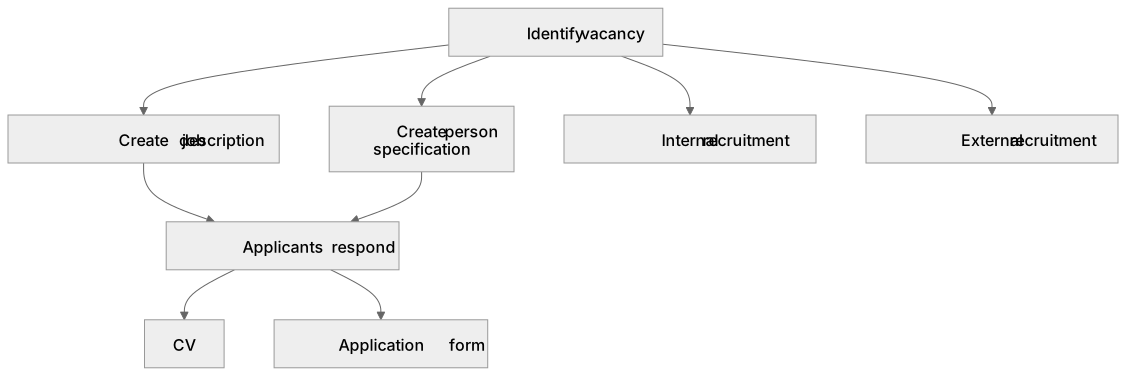
Recruitment begins with identifying a vacancy and creating key documents.
Checked against the Pearson Edexcel 1BS0 specification (opens in a new tab) on .
- Point 2 of 2
- 4 key terms
Study notes
From the checked teaching notes for this specification point.
The idea
Recruitment begins with identifying a vacancy and creating key documents. A job description outlines the duties and responsibilities of the role, while a person specification details the skills, qualifications, and experience required of the ideal candidate. Applicants respond using a CV (a personal summary of their history) or an application form (a standardised document created by the business). Businesses must choose between internal recruitment (promoting or moving existing staff) and external recruitment (hiring from outside). Internal recruitment is often faster and cheaper, whereas external recruitment brings fresh ideas and a wider pool of candidates to meet specific business needs.
What earns the marks
- Define a job description as a document detailing the specific tasks, duties, and responsibilities of the role.
- Define a person specification as a profile of the ideal candidate's skills, qualifications, and experience.
- Explain that application forms allow businesses to easily compare candidates, whereas CVs are formatted entirely by the applicant.
- Analyse the benefits of internal recruitment, such as lower advertising costs and existing knowledge of the employee's work ethic.
- Analyse the benefits of external recruitment, such as bringing new skills, fresh perspectives, and a larger talent pool into the business.
Common mistakes and how to put them right
Confusing a job description with a person specification.
Put it right: The job description is about the role itself, while the person specification is about the applicant.
Assuming internal recruitment always involves a promotion.
Put it right: Internal recruitment can also be a lateral move to a different department or a similar role.
Stating that CVs are created by the employer.
Put it right: CVs are written by the applicant, whereas application forms are designed by the employer.
Exam tips
- When evaluating recruitment methods, always link the choice between internal and external recruitment to the specific context of the business, such as its budget or need for new ideas.
- Use the terms 'job description' and 'person specification' accurately when discussing the early stages of the recruitment process.
- Consider the time and cost implications of different recruitment documents, noting that application forms take time to design but speed up the shortlisting process.
Try the lesson
The start of the Effective recruitment: How businesses recruit people: ● documents: person specification and job description, application form, CV ● recruitment methods used to meet different business needs (internal and external recruitment). lesson, made from checked teaching notes for this specification point.
Have a go first
Which recruitment document details the qualifications, skills, and experience a candidate needs to successfully perform a specific role?
Listen
Recruitment begins with identifying a vacancy and creating key documents. A job description outlines the duties and responsibilities of the role, while a person specification details the skills, qualifications, and experience required of the ideal candidate. Applicants respond using a CV (a personal summary of their history) or an application form (a standardised document created by the business). Businesses must choose between internal recruitment (promoting or moving existing staff) and external recruitment (hiring from outside). Internal recruitment is often faster and cheaper, whereas external recruitment brings fresh ideas and a wider pool of candidates to meet specific business needs. A strong answer earns marks for these points. Define a job description as a document detailing the specific tasks, duties, and responsibilities of the role. Define a person specification as a profile of the ideal candidate's skills, qualifications, and experience. Explain that application forms allow businesses to easily compare candidates, whereas CVs are formatted entirely by the applicant. Analyse the benefits of internal recruitment, such as lower advertising costs and existing knowledge of the employee's work ethic. A common slip: Confusing a job description with a person specification. Instead, the job description is about the role itself, while the person specification is about the applicant. Exam tip: When evaluating recruitment methods, always link the choice between internal and external recruitment to the specific context of the business, such as its budget or need for new ideas.
See it
Key words
Say what each word means before you turn the card.
Job description
Try answering aloud or in your head before turning the card.
Person specification
Try answering aloud or in your head before turning the card.
Internal recruitment
Try answering aloud or in your head before turning the card.
External recruitment
Try answering aloud or in your head before turning the card.
See every definition
- Job description
- A document outlining the duties and responsibilities of the role.
- Person specification
- A document detailing the skills, qualifications, and experience required of the ideal candidate.
- Internal recruitment
- Promoting or moving existing staff to fill a vacancy.
- External recruitment
- Hiring from outside the business to fill a vacancy.
Label the diagram
Some boxes have lost their names. Pick the right name for each number.
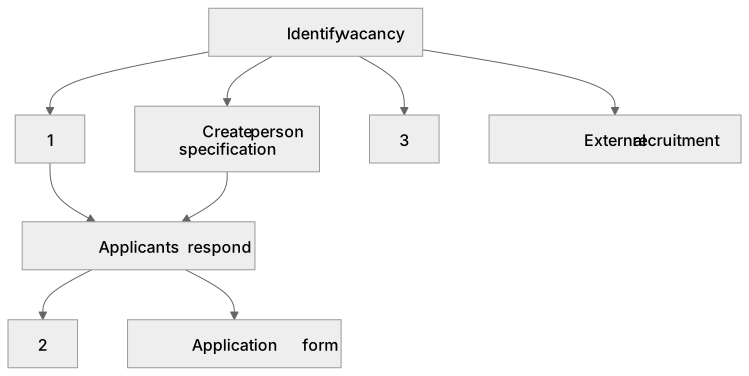
1Box 1
2Box 2
3Box 3
There is more to this lesson
The full lesson goes on to check your understanding and help you earn the marks. Create a free account to carry on, with your progress saved.
A week of Premium from your first lesson · Then the free plan continues · No card, no charge
Test your understanding of Effective recruitment: How businesses recruit people: ● documents: person specification and job description, application form, CV ● recruitment methods used to meet different business needs (internal and external recruitment).
Active recall beats re-reading. Take an instant quiz now to test what you’ve learned and lock it into long-term memory.
A week of Premium from your first lesson · Then the free plan continues · No card, no charge